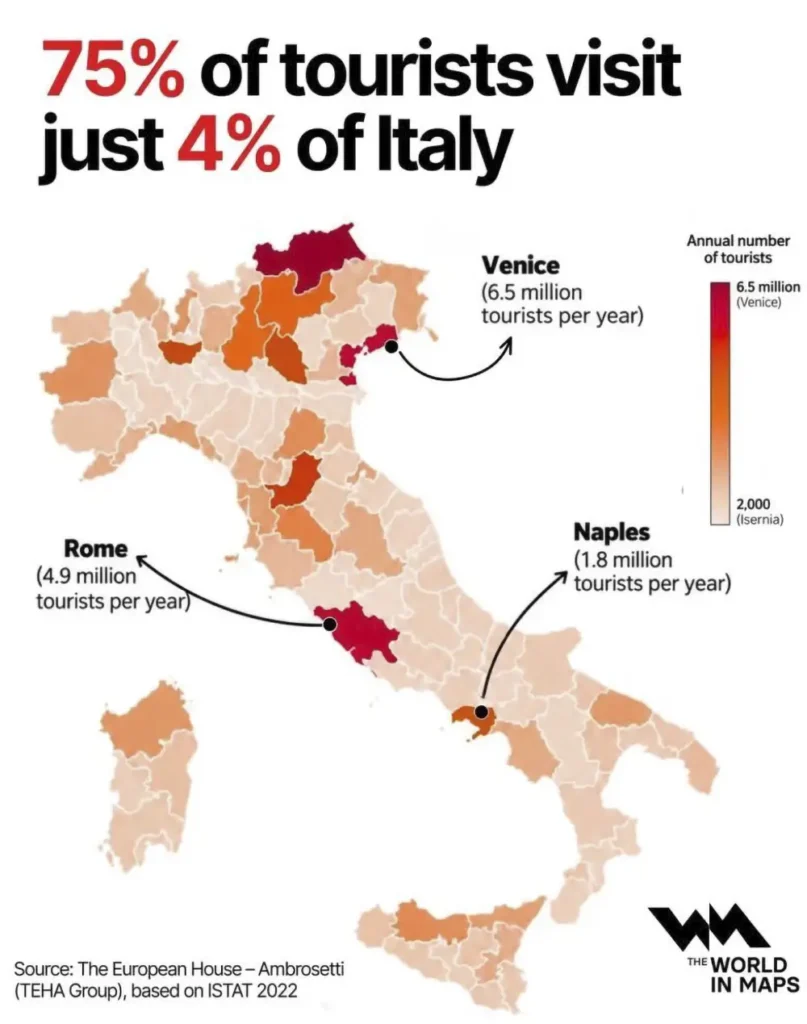
Italy has a tourism concentration problem. According to The European House – Ambrosetti (TEHA Group), based on ISTAT 2022 data, 75% of tourists visit just 4% of Italy.
The figure is striking because it describes more than overcrowded streets, queues at famous attractions or the difficulty of managing visitor numbers in places that have become victims of their own success. It raises a broader question: how does an entire country, with twenty regions and an extraordinary variety of landscapes, cultures, food, architecture and traditions, end up concentrating so much tourism in such a small part of its territory?
Rome, Florence, Venice and the Amalfi Coast are not popular by accident. They have internationally recognised identities, established transport connections, cultural significance and decades of accumulated visibility. Millions of travellers know what they can expect before they arrive. Choosing these places feels like a safe decision, particularly for someone visiting Italy for the first time.
The problem is not that these destinations are attractive. The problem is that so many other places struggle to enter the same decision-making process.
And Italy is hardly alone. International tourism repeatedly concentrates around a relatively small number of familiar destinations, leaving many other places competing for the attention of travellers who may have little reason to consider them in the first place.
For destination managers, tourism businesses and independent hotels, this is a branding and positioning problem as much as a question of tourism promotion. It is also an opportunity to reconsider what happens after a destination has attracted its first-time visitors.
Overtourism is only half the story
Overtourism tends to be discussed from the perspective of destinations receiving too many visitors. The consequences are tangible: pressure on infrastructure, rising housing costs, crowded public spaces, environmental damage and a deterioration in the experience of both residents and travellers.
Those problems deserve attention in their own right. Redistributing tourism cannot, by itself, resolve housing shortages, transport limitations or the environmental impact of excessive visitor numbers.
However, there is another side to the same phenomenon. While some destinations struggle to accommodate demand, other places with potentially compelling attractions, established hospitality businesses and distinctive local cultures remain largely outside international travellers’ consideration.
The contrast is not necessarily between places worth visiting and places that are not. It is often between places people already know how to choose and places they have never seriously considered.
A traveller planning a first trip to Italy may immediately think of Venice, Florence or Rome. Someone visiting England might begin with London, Edinburgh or Manchester. Copenhagen occupies a similar position in Denmark’s international image, while New York, Los Angeles, Miami and Chicago are among the familiar reference points for visitors planning a trip to the United States.
Other places can offer equally meaningful experiences for particular travellers. York and Bath have distinct historical identities. Aarhus, Odense and Roskilde offer different ways to experience Denmark. Smaller American cities and towns can appeal to visitors interested in architecture, food, music, outdoor activities or local history.
The important distinction is that these places do not need to appeal to everybody. They need to become relevant to the right people.
That is where destination branding begins to matter.
Visibility does not automatically create desirability
A destination can invest in advertising, attend international travel fairs, publish attractive photographs and increase its presence on social media without substantially changing the way potential visitors perceive it.
The reason is simple: awareness and preference are different things.
A traveller may know that a town exists without understanding why it would be worth visiting. They may recognise its name but have no clear picture of what they could experience there, how long they should stay, what makes it different or why it deserves a place in their itinerary.
More exposure can make a destination more familiar. It does not necessarily make it more desirable.
This is why destination marketing cannot stop at communicating attractions. A collection of monuments, restaurants, museums, landscapes and local products does not automatically translate into a compelling reason to visit. Those elements need to form a recognisable proposition that helps a particular audience understand what the destination offers and why it might matter to them.
The distinction is closely related to the difference between a product and a brand. In the destination context, the product is everything a place can offer; the brand is the meaning, expectations and associations that influence how people perceive and choose it. The two are connected, but they are not interchangeable.
The Brand vs Product Strategy: Brand USA and Authority Escape case explores this distinction through destination branding. Its relevance here is that a destination’s attractions do not communicate their own value automatically. Someone has to make sense of them, organise them into a meaningful proposition and establish why that proposition deserves attention.
This does not mean inventing an identity or turning every small town into a supposedly undiscovered paradise. It means identifying what is genuinely distinctive, understanding who might value it and making that connection clear enough to influence a travel decision.
A destination that tries to appeal to every possible visitor often ends up communicating a familiar collection of generic promises: culture, nature, gastronomy, authenticity and unforgettable experiences. Almost everywhere can claim some combination of those things.
The more useful question is what makes this particular place worth choosing.
The answer is not to redirect every tourist somewhere else
When popular destinations become overcrowded, the temptation is to promote less-visited alternatives. The logic is understandable, but simply telling people to visit somewhere else rarely solves the underlying problem.
A place does not become a compelling destination because another one is full.
Visitors still need a reason to go. They need to understand what they can do there, whether it matches their interests, how to reach it, where to stay and whether the experience justifies the time and money involved. In some locations, transport, accommodation capacity or the availability of visitor services may be genuine constraints that marketing cannot overcome.
Destination development therefore requires more than a campaign designed to move attention from one location to another. It requires a credible offer, the infrastructure to support it and a positioning that makes its value understandable.
There is also a risk in treating less-visited destinations as interchangeable alternatives to famous ones. A small town does not need to imitate Florence, and a rural destination does not need to recreate the experience of a major city. Trying to compete on the same terms as an established destination is often an unnecessarily difficult battle.
The more promising route is to identify a different reason to visit.
For one place, that might be a particular food culture. For another, a landscape, a historical period, a craft tradition, an outdoor activity or the possibility of experiencing everyday local life. The attraction may be highly specific, which is precisely why it can resonate with a well-defined audience.
The challenge is not to make every destination famous. It is to make each destination more meaningful to the people most likely to appreciate it.
The repeater opportunity: the next trip does not have to repeat the first
There is another way to approach the concentration problem, and it starts with a traveller who already knows the country.
Consider someone from the United Kingdom who has visited Italy twice. Their first trip might have included Rome and Florence; the second, Venice and the Amalfi Coast. Those experiences may have been excellent. They may also have left the traveller interested in returning without necessarily wanting to repeat the same itinerary.
What would persuade that person to explore Umbria, Basilicata, the Marche or a smaller destination in northern Italy?
The same question applies elsewhere. Someone who has already visited Copenhagen might be interested in discovering Aarhus or Odense. A repeat visitor to the United States might want a smaller city, a particular region or a place connected to an interest that a previous trip did not accommodate.
These are possibilities, not automatic behaviours. Repeat visitors may return to the same destination for good reasons, and familiarity with a country does not guarantee curiosity about its less-known places. Nevertheless, they represent an audience with a different starting point from first-time visitors.
They already have a reason to travel to the country. They may understand its culture, feel comfortable navigating it and have a clearer idea of what they enjoy. The next decision is not necessarily whether to visit the country at all, but what to experience there this time.
That creates an opportunity for destination organisations and hospitality businesses: instead of treating every trip as an isolated acquisition exercise, they can build reasons for travellers to return and explore further.
A destination could encourage previous visitors to discover a different part of the region, return in another season or experience something they did not have time for on their first visit. An accommodation business could maintain a relationship with past guests, understand what they valued and introduce experiences that are genuinely relevant to their interests.
The objective is not to turn every guest into an ambassador through a generic email sequence. It is to give people a credible reason to consider another trip.
There is a significant difference between asking someone to come back and showing them why coming back would be worthwhile.
Destination branding must create a reason to choose, not just a recognisable image
A destination’s identity is often communicated through a familiar collection of visual elements: a logo, a colour palette, a campaign slogan, photographs and a few recognisable landmarks.
These elements can be useful, but they cannot compensate for an unclear proposition. If a destination has not established what it wants to mean to a particular audience, a new visual identity may simply make the same generic message look more polished.
The challenge is to connect the destination’s actual offer with a meaningful reason to choose it, while ensuring that the experience can deliver on the expectations being created.
The Dynamic Identity Architecture: The LA28 Platform Brand Case Study provides a useful perspective on how a brand can operate as a broader platform rather than a single static visual expression. For destinations, this matters because a region or town rarely has just one story to tell. Different audiences may be interested in different aspects of the same place, but those experiences still need to belong to a coherent identity.
A destination can promote gastronomy to one audience, outdoor activities to another and cultural heritage to a third without becoming three unrelated brands. The common foundation is the destination’s positioning: the underlying meaning that connects its different experiences and helps people understand what makes the place distinctive.
The same principle appears in The Swedish Prescription, which examines destination branding through the lens of how a country presents itself. The wider lesson is that a destination’s appeal is not simply a list of things to see. It is the way those elements are interpreted, connected and made relevant to the people being invited to experience them.
This is particularly important for smaller destinations. They may not have the resources to compete with major tourism brands on advertising reach, but they do not necessarily need to. A clear, specific proposition can help them attract people who are actively looking for the experience they offer, rather than trying to win the attention of everybody.
The same logic applies to independent hotels within those destinations. A property does not need to represent everything the area has to offer. It needs to understand which aspects of the destination matter to its intended guests and how its own experience can make those aspects more compelling.
Independent hotels are part of the destination’s appeal
Hotels are often treated as the infrastructure that supports a destination: places where visitors sleep between activities. That view misses part of their potential role.
For many travellers, the accommodation is an important part of the experience itself. The hotel may introduce them to local food, suggest places they would not otherwise discover, explain the character of the area or help them understand how to spend their time. The quality and relevance of those interactions can influence how the guest perceives the destination as a whole.
This does not mean every hotel should become a tourism office or attempt to solve the destination’s marketing problems. It means recognising that the property’s commercial proposition and the destination’s appeal are connected.
A hotel that understands its guests can recommend experiences that match their interests rather than simply handing out a generic list of attractions. It can build packages around activities that give people a reason to stay longer, visit outside peak periods or return for a different experience. It can also communicate what makes the surrounding area worth discovering, instead of relying exclusively on the destination’s most famous landmarks.
The relationship works in both directions. A distinctive destination can strengthen the hotel’s positioning, while a well-positioned hotel can help visitors appreciate aspects of the destination they might otherwise overlook.
This is particularly relevant for independent properties whose appeal depends on more than room features and price. Their knowledge of the local area, relationships with local producers and ability to offer a coherent experience can become part of the reason a guest chooses them.
However, the connection needs to be genuine. Adding a local product to the breakfast buffet or mentioning a nearby village on the website does not automatically create a meaningful proposition. The experience has to make sense for the guest and reinforce the reason the hotel wants to be chosen.
From visitor acquisition to a longer relationship
Tourism promotion is often evaluated through the number of arrivals, bookings, website visits or campaign conversions it generates. Those metrics matter, but they do not tell the entire story.
A first visit can be the beginning of a relationship with a country, region or destination. Whether that relationship continues depends on the experience itself, the traveller’s circumstances and the availability of compelling reasons to return.
For destination organisations, this means considering not only how to attract first-time visitors but also how to encourage previous visitors to explore more. For hotels, it means looking beyond the immediate reservation and understanding what could make a guest choose the property again, recommend it to someone with similar interests or return to the area at another time of year.
That requires more than collecting email addresses. It requires delivering an experience worth remembering, understanding what mattered to the guest and communicating future opportunities that are relevant rather than repetitive.
A guest who came for a summer holiday might be interested in a quieter autumn stay. Someone who visited for a cultural event might return for food and wine. A couple who explored one part of a region might be interested in discovering another. The opportunity depends on the guest, not on a predetermined marketing calendar.
There is also a wider destination benefit. Encouraging repeat visitors to explore different places can help distribute some demand beyond the most familiar locations, provided those alternatives have the capacity and infrastructure to welcome them. It will not eliminate overtourism in the most popular destinations, but it can form part of a broader approach to creating more balanced and resilient tourism economies.
The key is to stop treating every visitor as a transaction that begins with a campaign and ends with a departure.
The rest of the country needs a reason to be chosen
The fact that 75% of tourists visit just 4% of Italy is a striking reminder of how unevenly tourism attention can be distributed. Yet the answer is not to make every place equally famous, nor to persuade travellers that the destinations they already love are somehow the wrong ones to visit.
The more useful objective is to expand the range of places people can imagine choosing.
That requires destinations to articulate what makes them distinctive, tourism organisations to connect their offers with the right audiences, and hospitality businesses to help turn that promise into a worthwhile experience. It also requires investment in the practical conditions that make a visit possible and enjoyable.
For independent hotels, there is an additional opportunity: to become part of the reason someone discovers a place, enjoys it and wants to return. Not by selling every attraction in the surrounding area, but by understanding what their guests value and connecting that value to experiences worth having.
The next visitor will always matter. So will the person who has already visited once, enjoyed the experience and might be ready to discover somewhere new.
A country does not need every tourist to visit every destination. It needs more travellers to have a reason to look beyond the places they already know.
And the places waiting beyond that familiar map need to give them a reason to choose them.