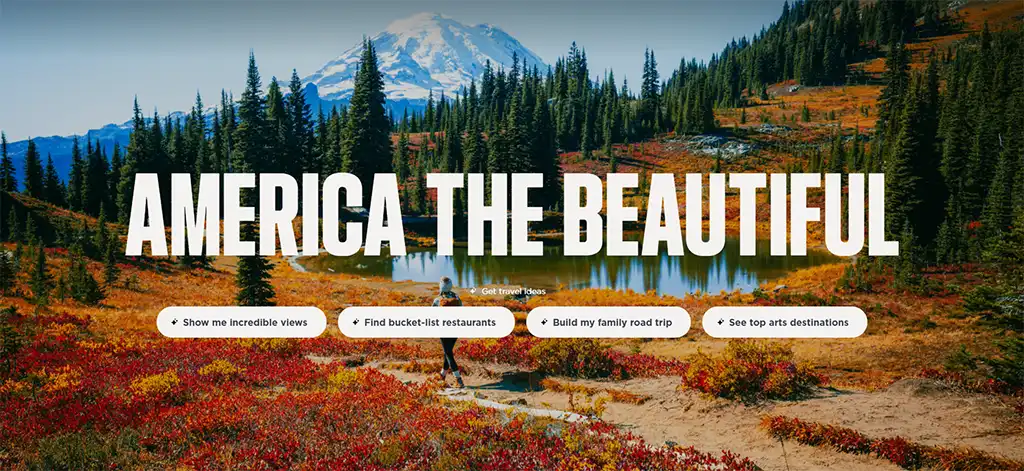
Brand USA is launching its largest marketing campaign ever: “America the Beautiful.” On paper, it looks like a show of force to celebrate 2026—the FIFA World Cup, the 250th anniversary of the Declaration of Independence, and the Route 66 centennial.
Scratch the surface. This is not a celebration. It is a rescue mission.
While the country prepares to host the world, international visitor numbers project a 6.3% decline from 2025 metrics. The data is clear. This is a massive defensive rebrand to repair a severe reputational crisis.
The Problem: When Brand Contaminates Product
This is a textbook case of what I call “Brand vs. Product” asymmetry. It occurs when your underlying asset is excellent, but the overarching corporate brand erodes its market value.
Let’s break down the assets:
- The Product (America): A 5-star inventory. The Grand Canyon, the New York skyline, pristine national parks. The physical product is intact.
- The Brand (America): Bureaucratic, expensive, and hostile. Damaged by years of divisive international policies, trade tariffs, and aggressive border enforcement experiences.
Here is the foundational rule of positioning: when the brand is toxic, pushing the features of the product is useless.
In fact, it is counterproductive. International travelers no longer view the asset (the Grand Canyon) in isolation. They process it through a negative corporate filter—fear of administrative friction at the border. The brand contaminates the product.
If a starred restaurant is run by a chef who actively insults customers, the quality of the menu stops mattering. People stop going.
The 6.3% drop is not a loss of desire for the national parks; it is a total loss of trust in the brand.
The Framework: “Authority Escape” and Atomization
When your reputation erodes, you cannot sell technical features. You must restore trust. You must sell raw emotion. That is the exact strategy behind “America the Beautiful.”
The framework is defensive. Since the monolithic, institutional brand is compromised, they must bypass it. They stopped selling destinations and started selling “vibes.” As CMO Leah Chandler states, the goal is to “feel” and “taste” America, not just visit it.
This is an atomization strategy. They fragment a broken corporate brand into hundreds of untouched micro-brands.
They stop selling the continent; they sell the neighborhood. You do not buy the USA; you buy the specific experience of a New Orleans jazz musician, a Santa Fe artist, or a Portland chef. They leverage local sub-brands that still project authenticity, decoupling the positive customer experience from the negative political framework.
Technology drives this atomization. Their new AI hub is not a booking widget; it is an engineering engine. It allows the traveler to construct a personalized micro-itinerary based on preferred vibes, completely bypassing the massive, institutional national portal.
They stop selling the political entity. They sell human connection.
The Strategic Contrast: USA vs. Sweden
This defensive framework becomes clear when contrasted with “The Swedish Prescription” campaign we analyzed recently. Two excellent frameworks, opposite diagnoses.
Case 1: Visit Sweden (Authority Theft)
- The Problem: Sweden had zero reputational damage. The brand was safe, clean, and premium. The bottleneck was a lack of urgency. A Swedish vacation was a desire, not an immediate need.
- The Strategy: Offensive. They executed an “Authority Theft.” They borrowed the objective credibility of the medical profession to formally prescribe travel as a stress cure, medicalizing a desire to create a business need.
Case 2: Brand USA (Authority Escape)
- The United States faces the exact opposite issue. The institutional authority is massive but negative. The authority is the bottleneck.
- The Strategy: Defensive. Since their institutional authority is toxic, they must execute an “Authority Escape.” They mask the administration to protect the underlying product.
Sweden used external authority to elevate its product. The US must obscure its internal authority to salvage its product. Sweden medicalized a desire. The US must humanize a political liability.
The Operational Lesson
Strategy depends entirely on correct diagnosis. The US campaign is a multi-million-dollar admission of weakness masked as a massive celebration.
The message to the market is clear: “Ignore the White House, look at our baristas. Forget the politics, come for the stories. Our brand is in crisis, but our people are still beautiful.”
Personally, to protect my sanity, I am spending Christmas in Sweden.