The announcement that KFC is opening restaurants in Cortina d’Ampezzo and Madonna di Campiglio has sparked a debate about the future of mountain tourism in Italy.
For some, it is simply another commercial development. For others, it represents the growing homogenisation of destinations, where global brands, mass entertainment and standardised consumer experiences increasingly replace the distinctive character of local places.
But perhaps the most interesting aspect of the KFC in Cortina debate goes beyond fried chicken, fast food or the presence of an American brand in the Italian Alps.
It raises a much bigger question: what happens when people travel around the world but never really leave their own cultural comfort zone?
KFC in Cortina: Why Is Everyone Talking About It?
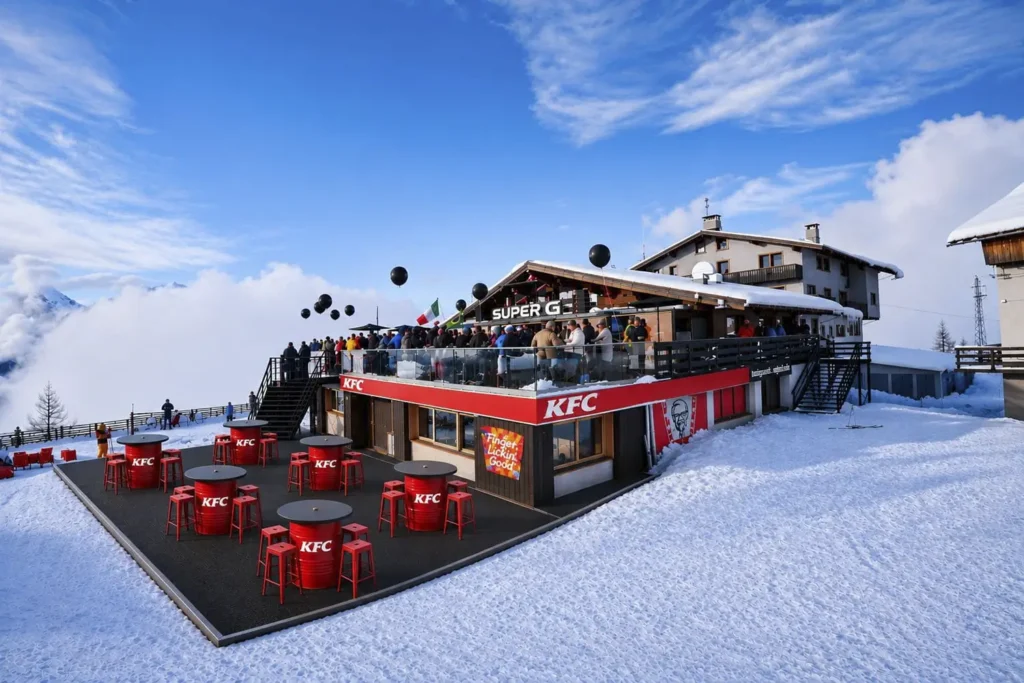
KFC, the American fast-food chain specialising in fried chicken, has announced its first directly operated restaurants on Italian ski slopes, with openings planned in Cortina d’Ampezzo and Madonna di Campiglio for the 2026/27 winter season.
The initiative comes through a partnership with Super G, the Italian mountain club operator known for combining mountain hospitality, food, music and entertainment.
The two locations are particularly symbolic. One will be situated in the Monte Faloria-Cristallo area of Cortina, at approximately 2,123 metres above sea level. The other will open in the Piana di Nambino area of Madonna di Campiglio, at around 1,700 metres.
The announcement has inevitably attracted criticism.
Environmental and mountain conservation advocates have questioned the direction of development in Alpine destinations, arguing that the mountains are increasingly becoming a backdrop for luxury brands, commercial entertainment and standardised consumer experiences.
Their concerns extend beyond one restaurant chain. They reflect a wider debate about the kind of tourism that mountain destinations are choosing to promote.
And that is where the discussion becomes particularly interesting.
The Tourist Who Travels Without Leaving Home
Imagine an American tourist visiting the Italian Alps and looking for KFC.
Now imagine an Italian tourist travelling to New York, London or Tokyo and complaining that local restaurants don’t know how to prepare a proper carbonara.
Different nationalities, different destinations, exactly the same attitude.
The tourist travels thousands of kilometres but expects the experience to remain comfortably familiar. The surroundings change, but their habits, preferences and expectations do not.
There is nothing inherently wrong with enjoying familiar food or choosing an international brand while travelling. Nobody is obliged to experiment with local cuisine, visit museums or immerse themselves in local traditions.
The issue is not what individual tourists choose to consume. It is the growing expectation that destinations should reproduce familiar experiences regardless of their cultural, geographical or social context.
Travel becomes a change of scenery rather than an opportunity for discovery.
A mountain resort becomes another place to eat the same fast food, listen to the same music and consume the same brands available in major cities.
A foreign city becomes a place where visitors search for familiar restaurants, familiar products and familiar experiences.
The destination changes. The expectations remain untouched.
KFC in Cortina and the Market That Creates Its Own Demand
There is an obvious argument in favour of the KFC openings: if there is demand, why shouldn’t businesses satisfy it?
It is a legitimate commercial argument.
If visitors want fried chicken on the ski slopes, and an operator believes there is a profitable opportunity, opening a restaurant makes business sense.
The same reasoning applies to the evolution of après-ski venues into large entertainment clubs, or to mountain refuges becoming famous for a particular food experience that attracts visitors willing to queue for hours.
These businesses respond to consumer demand. They identify opportunities and develop products that people are willing to pay for.
However, there is something missing from the argument that the market simply provides what customers want.
Tourism businesses do not just respond to demand. They also help shape it.
The experiences destinations promote, the businesses they attract, the events they organise and the products they make available all influence what visitors come to expect.
A destination that consistently promotes entertainment, consumption, recognisable international brands and easily packaged experiences will inevitably contribute to attracting visitors who value those things.
Over time, the offer itself can influence the demand.
This creates a feedback loop: businesses develop products to satisfy existing preferences, those products become part of the destination experience, and the resulting experience attracts more visitors with similar expectations.
The market is not an independent force operating outside the destination. It is partly shaped by the decisions of those who develop and manage it.
When the Mountain Becomes a Backdrop
The controversy surrounding KFC in Cortina is part of a much broader transformation in mountain tourism.
Consider the evolution of après-ski.
Traditionally associated with relaxing after a day on the slopes, socialising and enjoying the atmosphere of mountain resorts, après-ski has increasingly evolved in some destinations into a major entertainment product.
Large venues, DJs, concerts, branded experiences and high-volume consumption have become central attractions.
There is nothing automatically wrong with modernising mountain hospitality or introducing new forms of entertainment. Tourism products cannot be expected to remain unchanged forever.
The question is whether these experiences still have a meaningful connection with the places in which they take place.
The same issue emerges when a mountain refuge becomes famous primarily because of a particular pancake, fritter or other food item, attracting enormous queues and turning the journey into little more than a way to reach a viral attraction.
The mountain itself risks becoming secondary.
Its landscape provides the setting, its altitude provides the novelty, and its identity becomes a marketing asset used to sell an experience that could potentially be replicated somewhere else.
At that point, the destination is no longer necessarily the reason people come. It is simply the location in which a particular product is consumed.
And that is a significant distinction.
A mountain experience does not have to be traditional, quiet or contemplative to be authentic. Contemporary music, international cuisine and modern hospitality can all become part of a destination’s evolving identity.
But when the connection between the experience and the territory becomes increasingly superficial, the destination risks losing one of its most valuable competitive advantages: its distinctiveness.
This is also why tourism experiences need to be understood as more than individual products or attractions. Their value often comes from the relationship they establish with the place, its people and its culture. This is a central aspect of experiential marketing in tourism: creating experiences that allow visitors to engage with a destination rather than simply consume something within it.
Destination Positioning: What Kind of Tourism Do We Want to Attract?
This brings us to a question that is particularly important for destination management and destination branding.
What kind of destination does a place want to become?
The answer cannot simply be that it wants to attract more visitors, generate more revenue or increase consumption.
Those are commercial and economic objectives, not a positioning strategy.
A destination needs to understand what makes it distinctive, which audiences it wants to attract, what kind of experiences it intends to offer and how those experiences contribute to its long-term identity.
This is not an abstract branding exercise. It has practical consequences for tourism development.
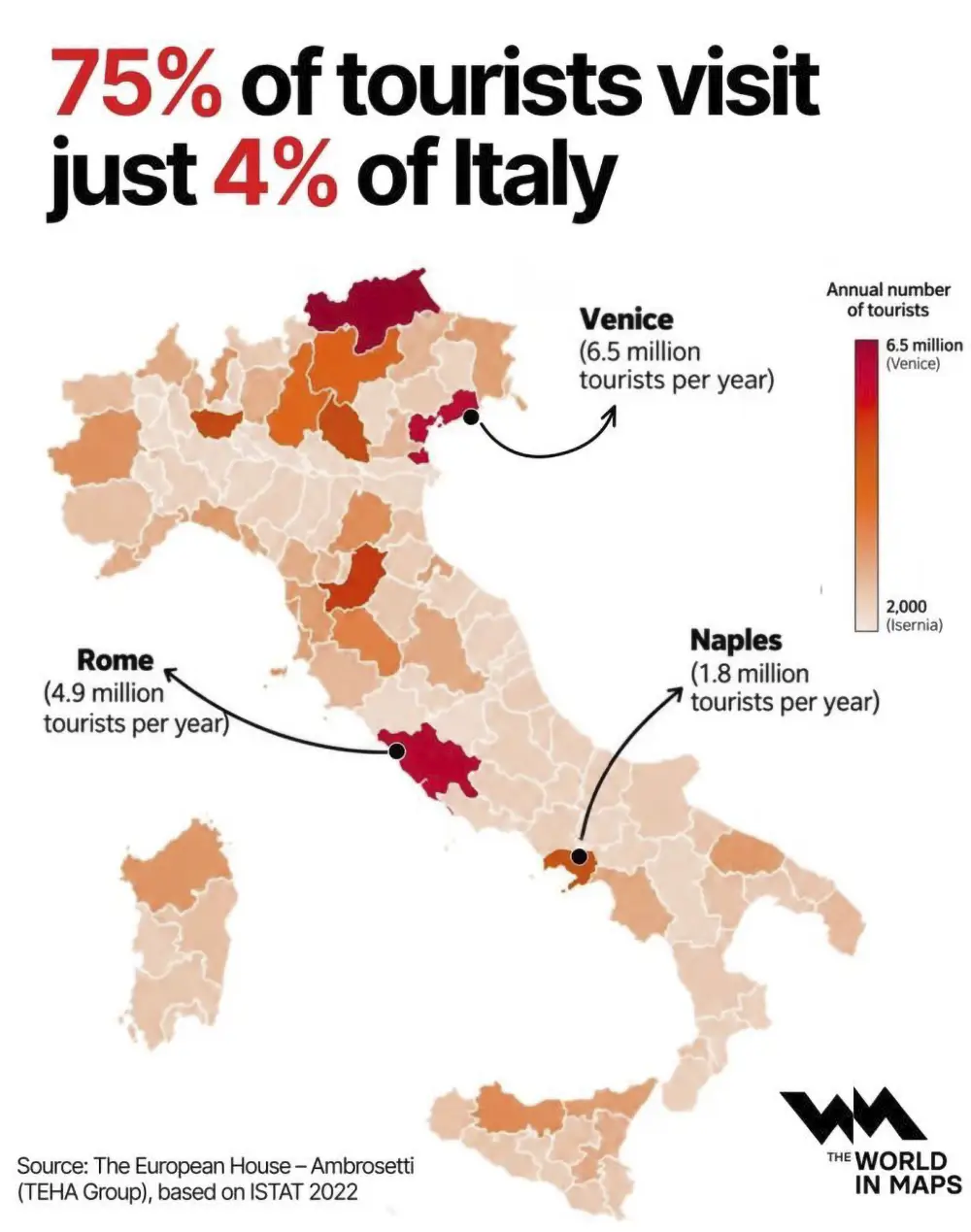
Consider the concentration of tourism in Italy. According to The European House – Ambrosetti, based on ISTAT 2022 data, 75% of tourists visit just 4% of the country.
As explored in 75% of Tourists Visit Just 4% of Italy. What About the Rest?, the challenge is not simply to redirect visitors towards less-known places. Destinations need to give people compelling reasons to discover them in the first place.
The same principle applies to the identity of established destinations.
A mountain resort does not need to reject international brands, modern businesses or commercial development. But it does need to understand how these choices contribute to the identity it wants to build.
A global restaurant chain can coexist with local businesses. Contemporary entertainment can coexist with traditional cultural experiences. A destination can evolve without losing its identity.
But coexistence does not happen automatically.
It requires decisions about land use, commercial development, tourism planning, local economic priorities and the overall direction of the destination.
It also requires recognising that not every commercially viable opportunity necessarily contributes to the long-term positioning of a place.
A business may be profitable while having little connection with the identity a destination wants to communicate. An attraction may generate enormous attention without creating meaningful benefits for the wider territory.
These distinctions matter.
There is an important difference between being different and being meaningfully positioned. The same principle applies to destinations as it does to businesses: simply having distinctive characteristics does not guarantee that people will understand or value them. The article Being Different Doesn’t Mean Being Well Positioned explores this distinction in the context of independent hotels, but its underlying logic is equally relevant to destination strategy.
Destination branding cannot be reduced to producing attractive images and communicating a collection of experiences. It must be consistent with the reality being developed and the type of tourism being encouraged.
Otherwise, the destination risks promoting an identity while gradually building something entirely different.
A Destination’s Identity Must Be Able to Evolve
There is another important distinction to make.
Preserving a destination’s identity does not mean freezing it in time.
Communities change. Businesses evolve. New generations develop different relationships with their territory. Tourism itself creates new opportunities and expectations.
A destination that refuses to evolve risks becoming irrelevant to future visitors and residents alike.
The challenge is to allow different expressions of identity without losing the underlying coherence that makes a place recognisable.
This is particularly interesting when considering destinations as brands.
A destination rarely has just one story to tell. It may have gastronomy, outdoor activities, cultural heritage, nightlife, architecture and contemporary entertainment. Different audiences may connect with different aspects of the same place.
The question is whether those experiences contribute to a coherent identity or simply turn the destination into a collection of unrelated commercial opportunities.
The Dynamic Identity Architecture: What LA28 Teaches Us About the Future of Branding explores how a brand can evolve through multiple expressions while retaining a recognisable underlying structure.
For destinations, this distinction matters. Flexibility does not have to mean inconsistency. Modernisation does not have to mean homogenisation.
A place can welcome new ideas and new businesses while maintaining a clear understanding of what makes it distinctive.
If Destinations Keep Giving Visitors What They Already Know, What Is Left to Discover?
The KFC in Cortina debate is not really about whether fried chicken belongs in the Italian Alps.
It is about the choices destinations make when deciding how to respond to tourism demand.
Visitors are entitled to enjoy their holidays however they want. Businesses are entitled to pursue commercial opportunities within the rules. But destinations also have a responsibility to consider the long-term consequences of the development they encourage.
There is a difference between giving visitors more choice and making every destination increasingly similar.
There is also a difference between modernising a tourism offer and replacing its distinctive characteristics with products that could be found almost anywhere.
The most successful destinations should not necessarily be those that can offer visitors everything they already know and enjoy.
They should be places that give people reasons to discover something they cannot experience in quite the same way elsewhere.
Because if destinations keep giving visitors what they already know, what exactly is left for them to discover?