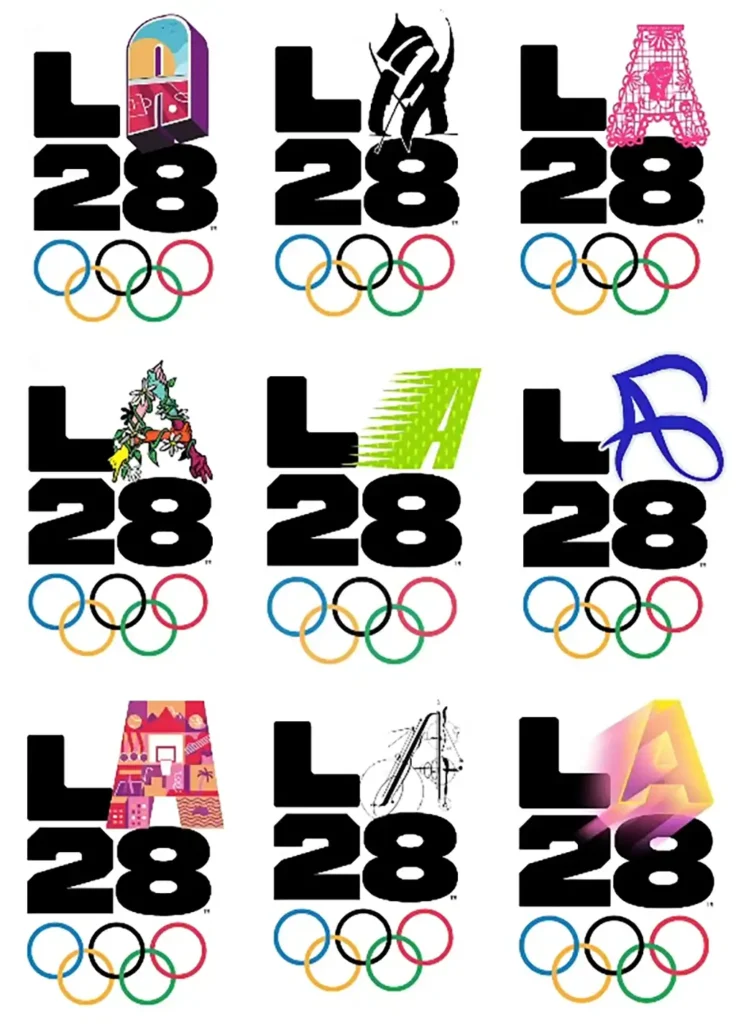
How do you design a visual identity for a city that refuses a single definition? For a market like Los Angeles—a decentralized ecosystem of conflicting cultures, narratives, and corporate ambitions?
The answer is programmatic: you don’t design a single logo. You deploy an infinite sequence of identities.
This is the strategic framework behind the Los Angeles 2028 Olympic identity. It is an intentional shift that moves past traditional graphic design to deliver a definitive statement on the future of brand architecture.
The Co-Creation Engine
The underlying system is built on data ownership and narrative distribution. The base architecture of the logo—the “LA28” text—is static, black, and geometrically rigid. It acts as the anchor, ensuring instant market recognition.
However, the letter “A” is designed as a dynamic container—a blank canvas engineered to shift continuously.
Crucially, these iterations are not random design exercises. They are powered by a strict co-creation framework, leveraging a multitude of organic voices. Elite athletes, digital creators, local activists, and global artists (such as Billie Eilish) inject their specific narrative directly into the brand asset. The LA28 identity is no longer a static broadcast; it is a live commercial conversation.
Strategic Analysis: Calculated ROI vs Operational Risk
Dismantling visual consistency is a high-stakes operational move. Let’s audit the architecture from an analytical perspective.
The Strategic Advantages (The Platform Shift)
- Community Equity: The brand shifts from talking to a demographic to being built by the demographic. This participatory framework secures immediate, organic cultural equity.
- Native Social Performance: In a digital ecosystem driven by scrolling algorithms, a static logo is a financial bottleneck. A dynamic asset is a content engine. Every new iteration generates fresh data points, driving organic engagement without exhausting media budgets.
- Radical Real-World Alignment: Los Angeles escapes monolithic classification. A multifaceted, evolving identity is the most honest, data-driven representation of a highly fluid market.
The Operational Risks (The Bottlenecks)
- Erosion of Recall Metrics: Standard positioning relies on rigid repetition to lock in market memory. Extreme fluidity—especially across static offline touchpoints, corporate signage, and merchandise lines—risks diluting immediate brand recall.
- Loss of Systemic Control: Handing the creative keys to an external community means ceding total control over your narrative asset. It requires massive systemic trust and opens the infrastructure to interpretations that may diverge from core corporate objectives.
- The “Gimmick” Vector: If the execution lacks operational weight, audiences may perceive it as a fleeting creative stunt rather than a solid infrastructure. The risk of looking like an engineered afterthought is a real corporate liability.
The Enterprise Lesson: visual Consistency vs Value Coherence
The LA28 model forces us to rewrite the dogmas detailed in traditional marketing manuals. The most critical takeaway is the evolution from a Monument Brand to a Platform Brand.
- The Monument Brand is rigid, top-down, and built to be passively consumed.
- The Platform Brand is an open infrastructure that enables and amplifies multiple distribution spokes under a single controlled hub.
This requires a sharp distinction between consistency and coherence. Visual consistency (using the exact same graphic output everywhere) is intentionally traded for a deeper layer of value coherence. Every variation of the logo is structurally unique, yet they all systematically broadcast identical core values: diversity, operational creativity, and inclusion.
Can a traditional commercial enterprise replicate this architecture? For a risk-averse financial institution, complete visual anarchy is operational suicide. But can they deploy the underlying philosophy? Absolutely.
Imagine a enterprise tech framework that allows senior engineers to sign off system communications with a validated, personalized variant of the corporate mark, or an asset management firm adapting its visual anchors to celebrate the specific performance metrics of its internal partners.
The scalable opportunities are infinite once you stop treating your visual identity as a static, sacred monument and start managing it as a live, adaptive system.
The ultimate question for modern CMOs is no longer: “Is our logo visually pleasing?” The strategic benchmark is now: “Is our brand system alive?”