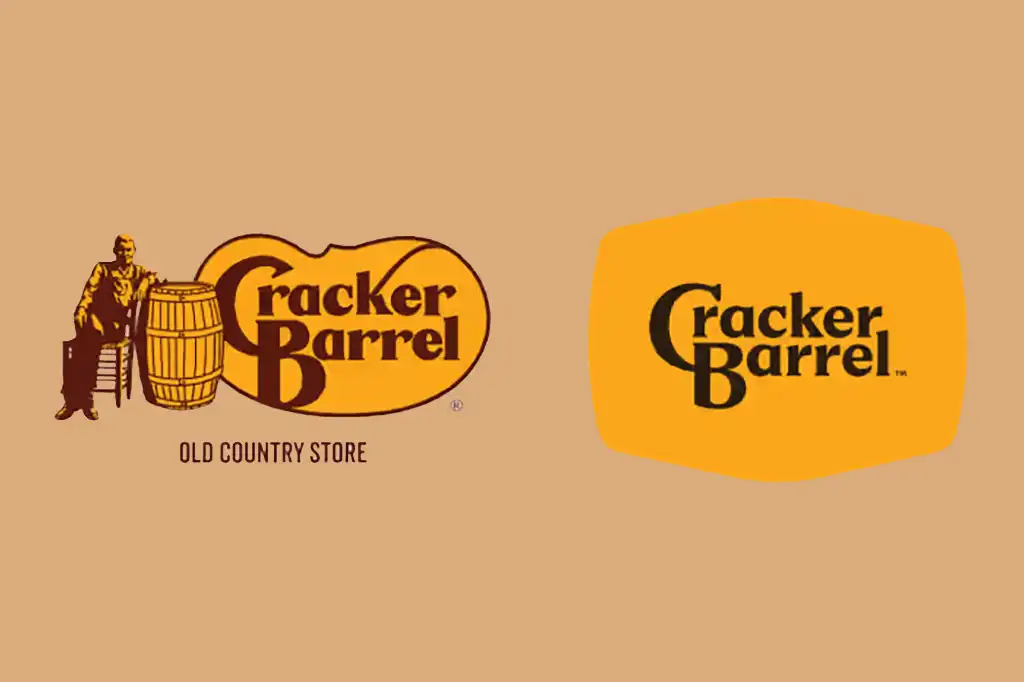
Imagine managing a corporate asset with over fifty years of market history, backed by millions of loyal customers. For months, your executive team develops an ambitious project: a total rebranding to “modernize” the visual identity, streamlining it for contemporary digital channels.
The launch day arrives. The board is proud of the output.
Exactly five days later, you are forced to execute one of the most humiliating strategic reversals in recent marketing history. You scrap the entire project and immediately reinstate the old, traditional logo.
This is the exact operational reality experienced by Cracker Barrel Old Country Store, an iconic American restaurant and retail chain. Their recent visual identity refresh triggered a consumer backlash of historic proportions. The fallout even drew sharp public criticism from political figures, condemning the decision to strip the brand of its heritage. The result? A costly, public retreat and a critical case study for any executive managing brand equity.
To analyze this failure as a simple aesthetic error is superficial. Cracker Barrel’s disaster was not a design failure; it was the direct consequence of severe corporate myopia.
Mistake #1: Confusing Heritage with Obsolescence
The primary strategic error committed by management was a fundamental misunderstanding of their underlying asset. Cracker Barrel does not merely distribute food and country souvenirs. They sell nostalgia. Their market positioning is embedded in their very name: an immersive, authentic experience of traditional rural America.
Their historic logo—featuring an elderly man on a rocking chair next to a wooden barrel—was not a “dated” liability requiring modernization. It was the purest, most systematic visual broadcast of their core brand promise. It was the asset, not the problem.
Management, likely influenced by the “blanding” trend that has homogenized global corporate identities, looked at the asset and saw a legacy issue. The market, however, looked at the logo and saw their own heritage—a baseline of comfort and authenticity in an unstable world. By attempting to modernize, the executive team attacked the core value proposition of the business, attempting to “cure” the exact symptom that drove their financial success.
Mistake #2: Eroding Emotional Equity and Community Ownership
This leads to the second critical operational blind spot. A mature enterprise brand with a deep historical footprint does not belong exclusively to its shareholders or board directors. It belongs, via emotional equity, to its community.
The aggressive consumer backlash was not a technical critique of typography or vector execution. It was a fierce defense of cultural equity and personal memories. When a brand asset reaches this level of cultural integration, it ceases to be mere graphic property.
Management operated under the illusion that the brand was their private sandbox, forgetting that millions of customers felt a sense of co-ownership over its identity. Treating a highly active, prideful community as a passive demographic to be “educated” into a new corporate template is a catastrophic miscalculation. The community didn’t consume the change; they revolted to protect their asset.
Mistake #3: Modernization as a Hollow Vanity Metric
The systemic pressure to “modernize” is one of the most dangerous traps in contemporary brand architecture. More often than not, these overhauls are driven by internal management vanity rather than objective market data.
Before disrupting an established identity system, leadership must answer critical operational questions: Are we actively losing market share? Is our historical demographic abandoning the asset? Is our current visual framework actively preventing us from acquiring a validated, high-ticket target audience? If the data says “no,” then modernization is a tactical change executed in a strategic vacuum.
In Cracker Barrel’s case, the operation looked exactly like that: an attempt to force a cold, minimalist template onto a brand whose entire value proposition is the antithesis of minimalism. It is the classic error of prioritizing the container over the content—worrying about a cleaner logo before validating what the asset represents to the market.
The Operational Lesson: When and How to Calibrate a Brand System
The Cracker Barrel reversal provides a definitive framework for risk management in brand strategy:
- Audit Before Action: A brand calibration cannot occur in an executive echo chamber. It must be the final output of deep audience auditing, mapping out the “sacred assets”—the untouchable core elements that hold the business’s emotional equity.
- Evolution Over Revolution: If visual optimization is required, execute it across secondary touchpoints first—digital UI layouts, backend software interfaces, secondary packaging lines—before touching the primary anchor. Gradual evolution protects your core client base while streamlining the asset.
- Define the Business Case: Never alter a historical brand asset to “look modern.” Change must solve a documented business bottleneck or capture a distinct, measured market opportunity. If it cannot be tied to revenue protection or market expansion, halt the project.
A brand is a living architecture backed by a protecting community. Treating it as a mere graphic file to be updated on a whim is the fastest vector to destroying market trust.
This framework highlights the principles of authenticity and structural coherence detailed in our core corporate manual, The No-Fluff Brand. If you are looking to build a resilient, high-ticket brand ecosystem that aligns with your real identity, explore our framework on Amazon.